Overview
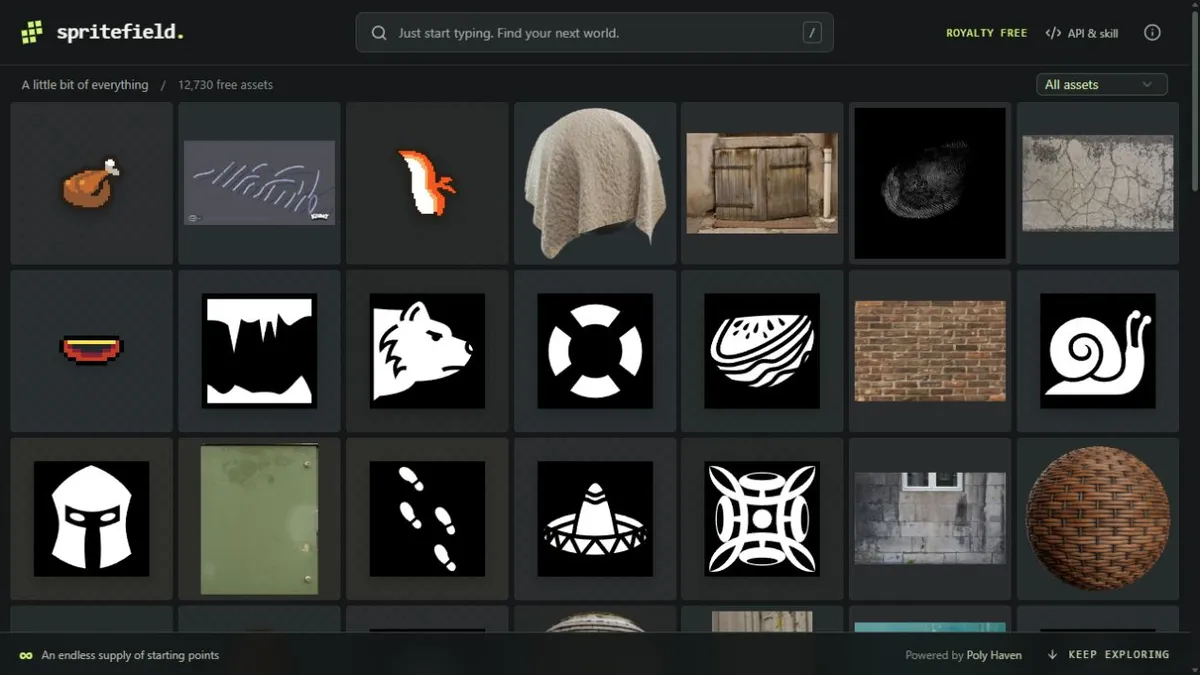
Spritefield is a visual search tool for game assets. Its canvas keeps previews close to the act of searching: type a query, filter by asset type, and bring relevant results into view.
The reviewed catalog snapshot contains more than 12,700 entries. Those include individual assets as well as complete packs, so an entry count is not a count of independently verified files.
Browsing and search
A virtualized grid renders the visible part of the canvas. Lazy previews, cursor pagination, and continuous scrolling let a large collection remain browsable without placing every image on the page at once.
Search uses weighted SQLite FTS5 indexing, related terms, and typo handling. When the system falls back to discovery suggestions, the interface labels that mode. A suggested asset should not be mistaken for a literal match to every term in a query.
The catalog loops after reaching its end. That behavior supports browsing; it does not imply that new assets are being generated or crawled continuously.
From a preview to usable files
The texture API distinguishes a preview from the original resource. It can resolve original photographs, archives, and separate PBR maps with their role, format, and available resolution.
The model API returns the main model file and companion resources, or a complete pack archive. For a glTF model, the companion buffer and texture files need to retain the relative paths described by the response. Choosing a different model resolution refers to texture size, rather than a different mesh complexity.
Some catalog records represent sprite sheets or packs. Texture photographs are not automatically seamless materials. The source and file details are part of deciding whether an asset fits a project.
Browser and agent interfaces
People browse the same catalog that agents can query. The project exposes a public API guide, an OpenAPI schema, a downloadable skill, and five browser WebMCP tools:
search_assetsfind_texturesget_texture_mapsfind_modelsget_model_files
Search returns IDs that can be passed to the corresponding detail endpoint. Following the returned cursor with the same query keeps pagination consistent.
Catalog architecture and updates
The application uses React and TypeScript with a Cloudflare Worker and D1. The checked-in catalog supplies metadata for the indexed database; preview imagery remains on the providers’ servers.
Refresh scripts update the Poly Haven texture and model records while preserving other reviewed provider snapshots. There is no background crawler. A refresh changes the catalog revision and needs a review before publication.
The source repository includes local setup, ordered database migrations, API generation, and catalog-update instructions.
Credits and use
I built the search and discovery software. The assets belong to their original creators and providers, including Poly Haven, ambientCG, Kenney, Game-icons.net, Superpowers, and Texture Ninja.
Each record carries source and license information. The software’s license does not relicense the indexed artwork; creator attribution and original terms remain attached to the asset.
Browse the live catalog or consult its API guide. The image above is a capture of the public catalog.