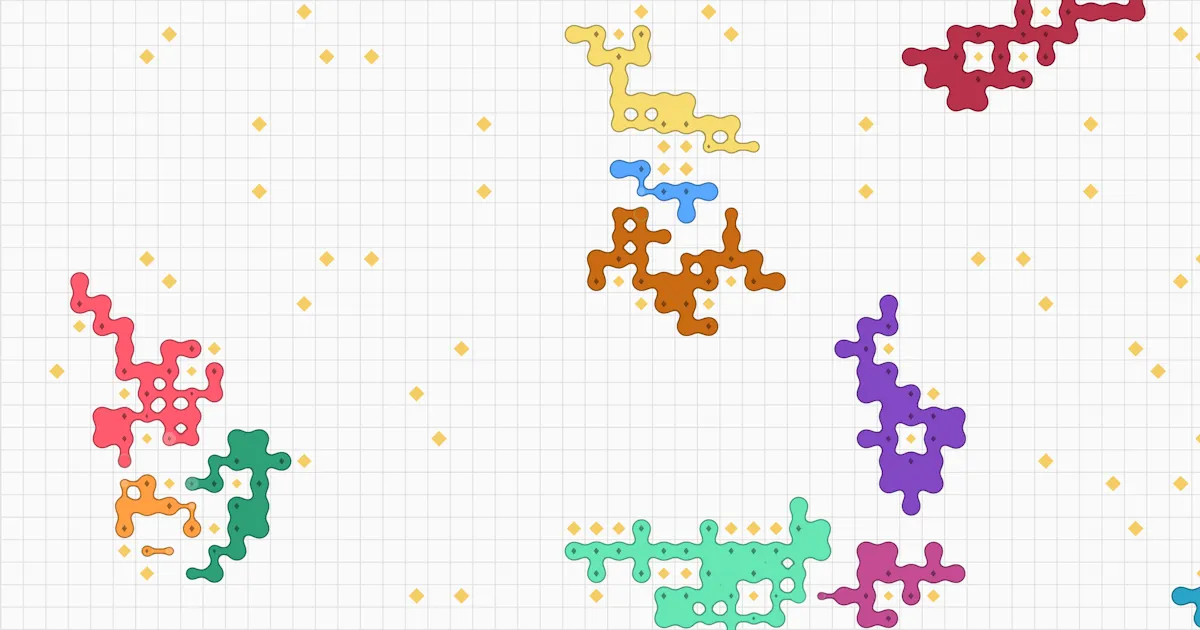
A big territory looks strong until you notice the one narrow connection holding it together.
That is the central idea in Goop Troops, my multiplayer strategy game. You grow across a board, compete for resources, and defend your territory. But the territory’s shape is part of its strength. An attack on a small connection can change the position of a much larger army.
Make the map part of the decision
A supply line gives the player something to read beyond the size of a force. Where is an opponent stretched thin? Which branch is exposed? Is another patch of territory worth the connection it takes to reach it?
That creates a tension between expansion and reinforcement. More territory creates opportunities, but also more places where the network can break. A narrow passage can be an asset when it is easy to defend and a liability when everything depends on it.
The interesting decisions come from the relationship between pieces of the board. The same rule applies across a small duel and a crowded public match, but the situations it produces look different.
Keep the simulation shared
The browser game combines a React and TypeScript client with shared simulation code and an authoritative Node.js service. The server owns the match state, so commands from different players resolve against one version of the board.
That distinction matters in a game about connections. If a cut changes which territory remains connected, everyone needs to agree on the result. Rendering and controls live in the client; deciding the shared outcome belongs to the server.
Build the ways into the game
The simulation is only one part of a playable game. Goop Troops also includes guest play, AI opponents, private rooms, teams, a tutorial, and ranked one-on-one matchmaking. Public matches support up to eight players.
Those are different ways to meet the same underlying idea: learn the board with bots, play privately with friends, or try a competitive match. Desktop and touch controls give the mechanic another set of constraints to work within.