Overview Link to section: Overview
I built Frontier Colony as a Roblox (a platform for creating and playing games) colony-survival prototype centered on autonomous settlers (colonists who carry out work on their own). Players establish a settlement, organize work, grow food, prepare shelter, research equipment, and respond to threats.
The project uses original Luau (Roblox’s scripting language) code and procedural 3D art (models created through code). Colony-management games such as RimWorld (games about organizing settlers’ work and survival) inspired the loop; their assets and proprietary code are not part of the project.
Starting a colony Link to section: Starting a colony
Map and starting conditions Link to section: Map and starting conditions
A new colony can use a standard start or a customized map, population, and supply kit. The setup includes:
- Terrain and climate choices.
- A starting season and difficulty.
- Colonist skills.
The terrain preview and playable map use the same generator. Map settings and starting conditions are saved with the colony.
Starting time Link to section: Starting time
Players begin with the simulation (the running model of the colony) paused and can inspect their people and resources before starting time. Each player’s colony has its own map, inventory, research, raids (attacks on the settlement), and clock.
People, work, and survival Link to section: People, work, and survival
Needs and priorities Link to section: Needs and priorities
Colonists operate within a network of needs and available work. Skills, schedules, equipment, health, relationships, and assigned priorities affect how the settlement functions.
The player has to connect those systems in practical ways: food needs storage and preparation, injured people need beds and supplies, and winter shelter needs usable rooms and heat. Crops and planted trees interact with soil, seasons, temperature, and regrowth.
Production and supplies Link to section: Production and supplies
Production orders (instructions to make goods) and hauling (moving supplies) link raw resources to usable goods. A stock ledger (an inventory record) and searchable workshop view expose that flow so a missing item can be traced back to its source or destination.
Construction and infrastructure Link to section: Construction and infrastructure
Buildings and utilities Link to section: Buildings and utilities
Construction includes material choices, research requirements, blueprints (plans for buildings), grouped placement, and dismantling.
Rooms track contents, cleanliness, and quality; power circuits (connected electrical systems) and temperature controls connect the built environment to survival.
Shared policies and the wider world Link to section: Shared policies and the wider world
Storage, food, clothing, and work policies (rules for colony behavior) are shared systems rather than isolated settings on each object. Assignments and default inheritance (using shared settings unless overridden) help a colony behave consistently as its population grows.
Procedural terrain (land generated through code), wildlife, research, combat, quests, and travel give the settlement a world beyond its immediate building area. These systems are in active development, so repository behavior can be ahead of the last private Roblox release.
Interface and cooperative editing Link to section: Interface and cooperative editing
Finding the right information Link to section: Finding the right information
A large part of my work is making the simulation understandable. Search locates people, objects, building plans, and controls. Linked inspectors (detail panels for selected items) let the player move from an alert to the relevant person, room, policy, or production order.
The interface supports desktop and touch layouts as well as keyboard navigation and map controls. Long lists reflow and scroll rather than depending on increasingly small text.
Reviewing shared changes Link to section: Reviewing shared changes
Cooperative editing creates a second state problem (keeping track of current and unfinished changes): a person’s unfinished settings draft may coexist with changes from another player. Policy and infrastructure editors preserve unsent drafts, expose conflicts, and ask for a review before applying an outdated change.
Persistence and testing Link to section: Persistence and testing
Roblox colonies save and reload across servers. Ordinary Studio (Roblox’s development editor) previews use temporary colonies so local experiments do not overwrite the owner’s published progress. The place file (the Roblox project file containing the playable world) is self-contained for local play in Studio.
Development tests cover simulation behavior, saved-state recovery (restoring stored colony data), and interface consistency. Multiplayer checks include shared edits and repeated navigation between panels.
Current access and imagery Link to section: Current access and imagery
Frontier Colony is a private playable prototype. Both the repository and Roblox experience remain private.
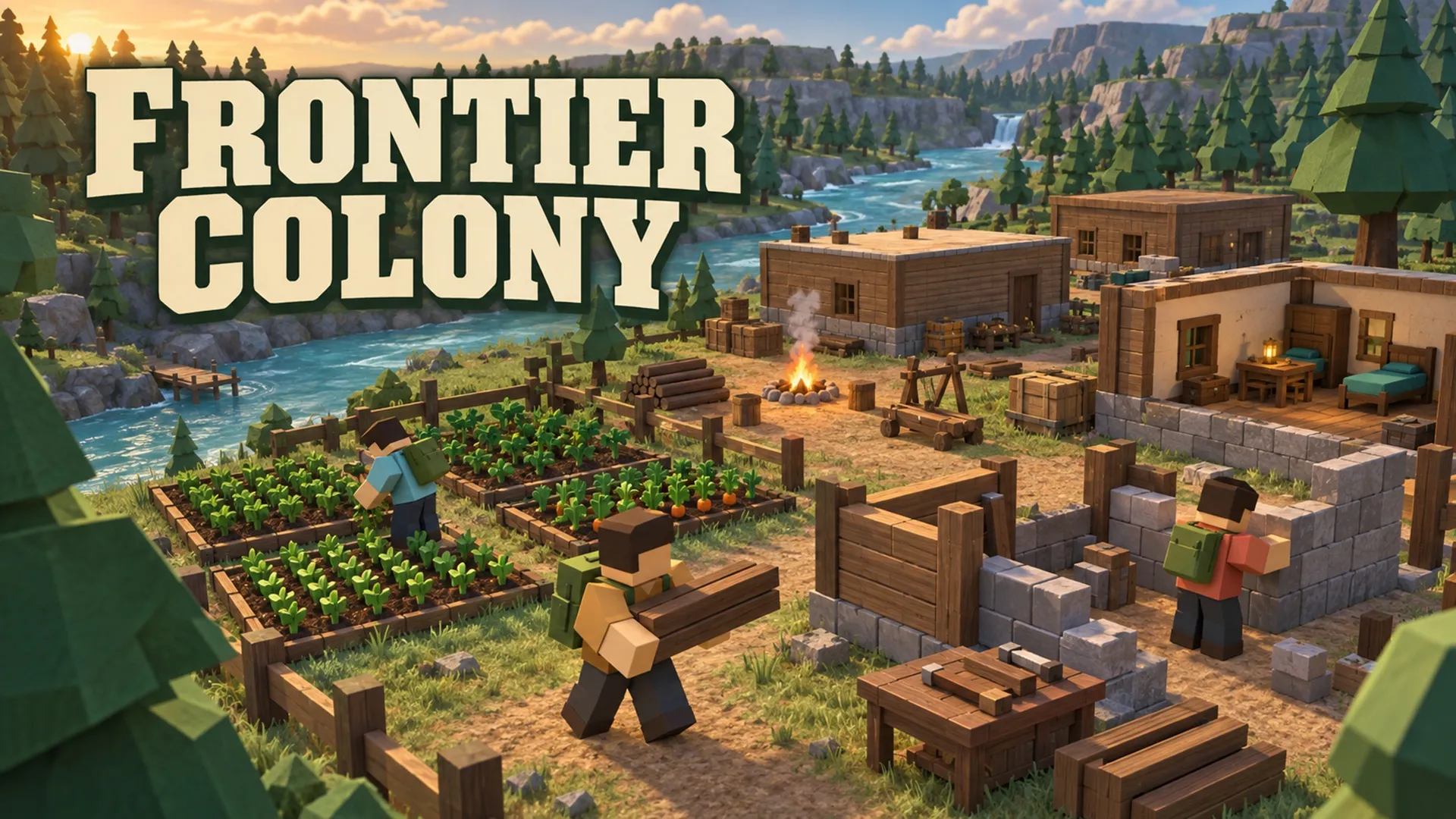
The cover is AI-generated promotional artwork depicting the intended setting, rather than a gameplay screenshot.
FAQ
Can I play Frontier Colony publicly?
It is a private playable prototype. Both the Roblox experience and repository remain private.
What does the player manage?
Players establish a settlement, organize autonomous settlers' work, grow food, prepare shelter, research equipment, and respond to threats.
Do colonies persist between sessions?
Roblox colonies save and reload across servers. Ordinary Studio previews use temporary colonies so experiments do not overwrite the owner's published progress.